

Table of Contents
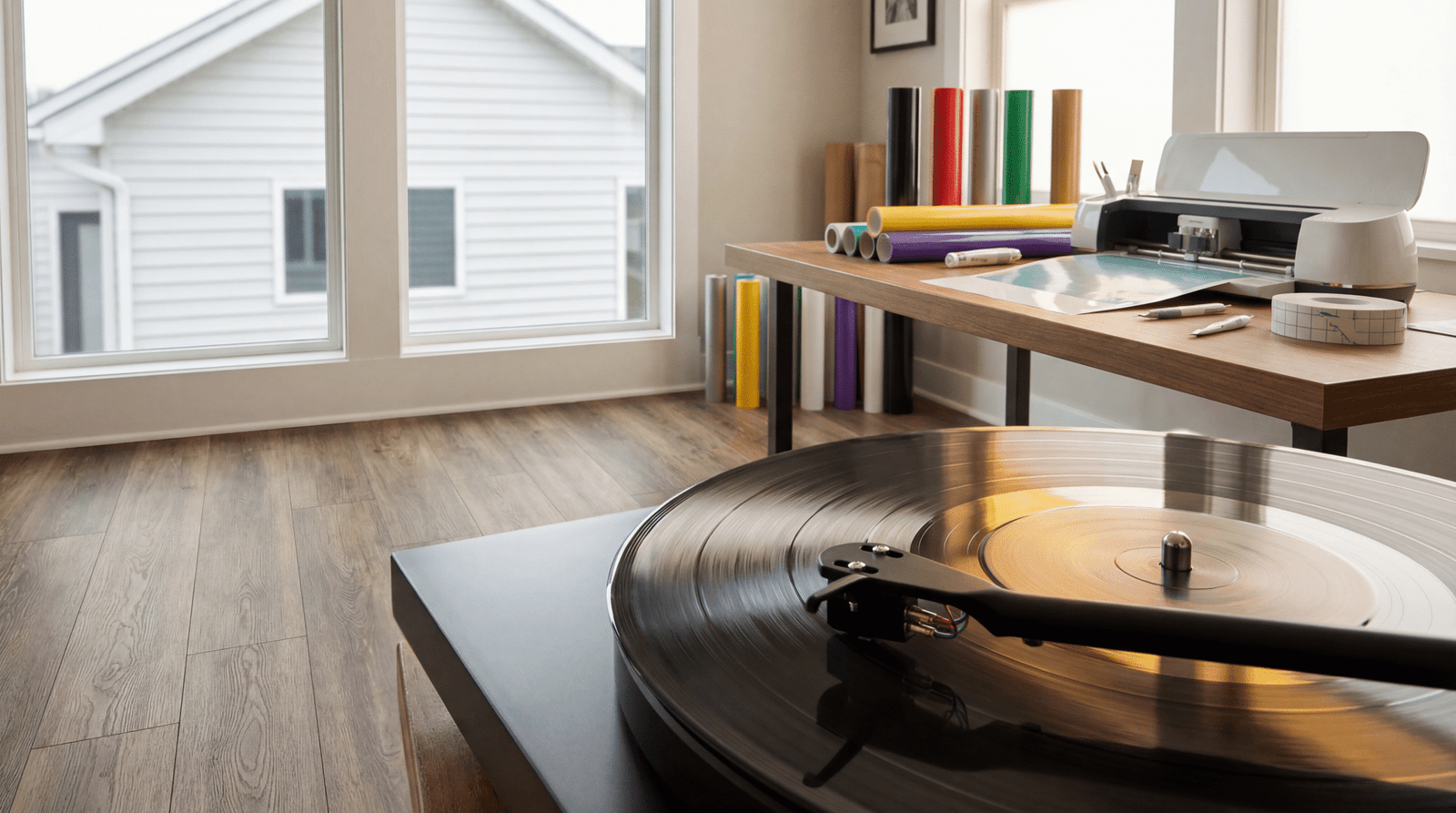
From analog music to modern construction and DIY projects, vinyl plays a central role across industries. It appears in phonograph records and turntables, resilient flooring and exterior siding, vehicle wraps, and precision craft films used with cutting machines like Cricut.
This guide explores the material’s origins and chemistry, explains how major product categories are manufactured and used, and provides practical advice on purchasing, installation, maintenance, and sustainability. Clear comparisons and safety considerations help homeowners, audiophiles, and makers choose wisely.
Origins and Material Science
Most products commonly referred to as vinyl are made from polyvinyl chloride (PVC), a versatile synthetic polymer. First identified in 1872 by Eugen Baumann, PVC became commercially viable in the 1920s after Waldo Semon introduced plasticization techniques that improved flexibility and durability. Today, global PVC output exceeds 50 million metric tons annually, placing it among the world’s most widely produced plastics.
PVC is formed by polymerizing vinyl chloride monomer (VCM). Industrial production relies on three main processes:
Suspension polymerization – the dominant method, producing uniform beads used in records, siding, and rigid profiles
Emulsion polymerization – creates fine particles suitable for films, coatings, and flexible sheets
Bulk polymerization – used for specialty grades with controlled purity
Unmodified PVC is rigid by nature, but its performance can be precisely adjusted using additives, allowing the same base material to function as a hard record surface, a flexible wrap film, or a weather-resistant building panel.
Key Material Characteristics
High resistance to chemicals and moisture
Stable dimensions under normal conditions
Adjustable flexibility through formulation
Good electrical insulation
Variable transparency and color control
Common Additives and Functions
Plasticizers (e.g., DOTP): increase flexibility for flooring and films
Stabilizers (calcium-zinc, tin): protect against heat and UV degradation
Titanium dioxide: improves brightness and weather resistance in exterior products
Mineral fillers: enhance rigidity and reduce cost
Impact modifiers: improve toughness in building applications
Environmental and health concerns include the toxicity of VCM, potential endocrine effects of some plasticizers, and harmful byproducts if PVC is improperly burned. In response, manufacturers increasingly use non-phthalate plasticizers, low-VOC formulations, and improved recycling streams—though material recovery remains complex due to additive diversity.
This ability to tailor PVC formulations laid the groundwork for one of its most iconic uses: analog sound media.
Records, Turntables, and Analog Media Care
Records made from PVC replaced shellac discs in the mid-20th century, enabling longer playtimes, lower surface noise, and greater durability. Sound is encoded as microscopic groove modulations that a stylus tracks, converting physical movement into electrical signals for amplification.
Essential Care Practices
Cleaning: Use a carbon fiber brush before play; for deeper cleaning, employ a wet record cleaning machine with distilled water and approved solutions (never household cleaners). Quick, lint-free microfiber wiping is optional for casual dust removal.
Storage: keep discs upright, away from heat and sunlight, at stable temperature and humidity
Handling: touch only the edges and center label
Turntable setup: correct tracking force, cartridge alignment, and anti-skate prevent groove damage
- Digitizing: Connect the turntable to a phono preamp/interface. Record in 24-bit/96 kHz for archival safety; clean each record before transfer.
Heavier pressings resist warping, while colored or picture editions may introduce slight surface noise due to altered formulations. Proper maintenance significantly extends lifespan and preserves sound quality.
The same polymer precision that supports audio fidelity also enables durability in residential construction.
Flooring and Siding in Residential Construction
PVC-based finishes are widely used indoors and outdoors due to water resistance, affordability, and design flexibility.
Flooring Types
Sheet flooring: seamless and water-resistant, ideal for kitchens and bathrooms
Vinyl composition tile (VCT): rigid, economical, common in commercial spaces
Luxury tile and plank (LVT/LVP): layered construction with realistic wood or stone visuals
These products vary in thickness, wear layers, and installation systems (glue-down, click-lock, or loose-lay), allowing homeowners to balance cost, durability, and DIY friendliness.
Exterior Siding
Siding panels are produced via co-extrusion, combining a durable core with a UV-resistant capstock. Thicker profiles offer improved rigidity, fade resistance, and impact performance. Maintenance typically requires only periodic washing.
While these materials resist moisture well, they are not fireproof and can release fumes during combustion, making ventilation and code compliance essential during installation.
Wrap Films and Graphic Applications
Decorative and protective wrap films transformed advertising and automotive customization in the late 20th century. Modern formulations allow conformability over complex curves while remaining removable.
Film Categories
Cast films: thin, highly conformable, long service life
Calendared films: thicker, cost-effective, best for flat surfaces
Advanced adhesive systems with air-release channels simplify installation and reduce bubbles. Wraps offer reversible design changes, paint protection, and faster turnaround than repainting, though lifespan depends on material quality and exposure.
Craft Films and Cutting Machine Projects
Craft applications rely on thin adhesive or heat-transfer films compatible with digital cutting machines.
Common Types
Removable adhesive films for temporary decals
Permanent adhesive films for signage and outdoor use
Heat-transfer films for textiles
Specialty options like holographic, printable, or textured sheets
Success depends on matching blade type, pressure, speed, and surface compatibility. Proper ventilation and safe heat practices are essential, especially for fabric transfers.
Conclusion
From music preservation to home improvement and creative design, vinyl remains one of the most adaptable materials in modern use. Its performance depends on formulation, application, and proper handling. By understanding how different PVC-based products are made, installed, and maintained, consumers can make informed choices that balance durability, aesthetics, health considerations, and environmental impact. Whether restoring analog audio, renovating a space, customizing a vehicle, or crafting personalized décor, knowledge ensures better results and longer-lasting performance.
Discover top-rated products and expert reviews